AI training fails after the workshop because it changes what one person knows and leaves the team's work exactly where it was. Microsoft has now said as much about itself. On 17 September 2026 it published that Copilot, licensed to over 200,000 of its own people, plateaued in sales until teams started from a business outcome and redesigned the workflow. After that, adoption of priority use cases tripled. Below: what Microsoft changed, the numbers, the footnotes worth reading, and how we run the same shift with client teams.
The Monday after the workshop
The workshop went well. Feedback averaged 4.6 out of 5. Someone put a prompt library in a shared drive, and the head of L&D sent a thank-you email with three exclamation marks.
Three weeks later, the usage dashboard is back where it started. The prompt library has four views. Two of them are yours.
Nobody did anything wrong. People went back to their desks, opened the same spreadsheet, answered the same forty emails and ran the same Thursday meeting. The tool was still there, a tab away. It just had no reason to be in the work, because the work hadn't changed.
If that's your quarter, Microsoft has just written up a very expensive version of it.
What did Microsoft learn from its own AI transformation?
Microsoft learned that deploying AI tools and training people to use them doesn't change how work gets done, and that the gains show up when a team starts from a business outcome and redesigns the whole workflow around it. Kathleen Hogan, Executive Vice President and Chief Strategy and Transformation Officer, set it out on the Official Microsoft Blog on 17 September 2026, drawing on what the company calls hundreds of internal transformation efforts, collected in its Frontier Playbook.
The admission that matters is in the first lesson. In Hogan's words:
"We initially treated AI like a traditional technology rollout: deploy the tools, provide training, drive adoption. We learned that access and usage do not equal transformation: a tool licensed to over 200,000 people does not change how the work gets done."
Kathleen Hogan, EVP and Chief Strategy and Transformation Officer, Microsoft
That's the company that sells Copilot, writing about Copilot, on its own blog. It's worth reading twice.
Microsoft groups what it learned into five lessons. Here they are, with what each one means for a team that has just finished its AI training.
| Microsoft's lesson | What Microsoft did | What it means after your training day |
|---|---|---|
| 1. Start with the business outcome, not the technology | Sales stopped pushing usage and started from goals: win deals, deliver value to customers. It mapped the account manager's week and matched a tool to each moment. | The workshop started from the tool's features. Start from a number someone in the room already owns. |
| 2. Redesign the entire workflow, not just individual tasks | The cloud supply chain team simplified its processes first, built a single source of truth, then deployed more than 100 purpose-built agents. | Making one step faster builds a queue at the next one. The unit of change is the whole flow, start to finish. |
| 3. Put employees at the centre of transformation | Camp AIR, a multi-week accelerator where cross-functional teams redesign their work around a real business challenge, now scaled to more than 3,000 engineers. | The people doing the work design the change, together. Managers go first and say so out loud. |
| 4. Use AI to expand what people can do | Microsoft calls it Capability Add: continuous improvement plus AI. "Efficiency is the floor; capability is the ceiling." | Measure what the team can now do that it couldn't, as well as the hours saved. |
| 5. Build a continuously learning organisation | The People team keeps improving the agents behind employee onboarding and decides where human judgement stays. | The learning loop stays with the team, and it survives the next model release. |
Five lessons, and the word "training" appears in the first one as the thing that didn't work on its own.
What changed when Microsoft stopped pushing adoption harder?
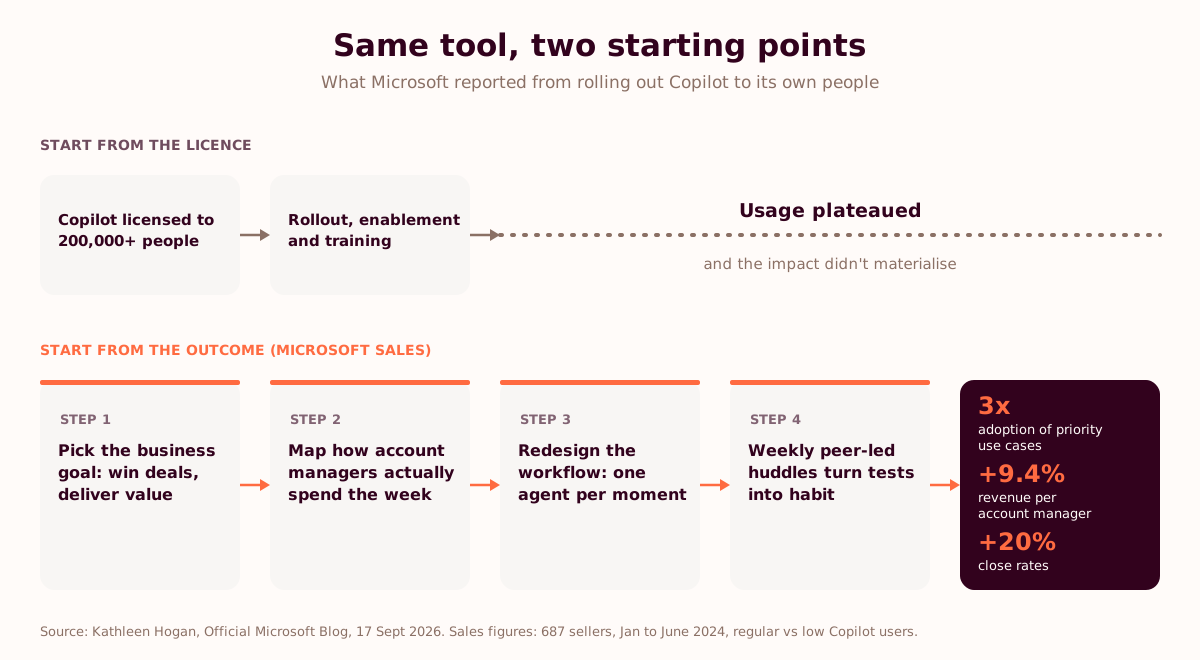
Sales is the clearest case. Copilot was deployed broadly, and in Hogan's words "usage plateaued and impact did not materialize." The team could have run another round of enablement. It didn't.
It went back to the business goals, then mapped how account managers actually spent their week. For the moments that mattered most, it picked a specific tool: an Analyst agent for pipeline, a Deal agent for deal packages, Researcher for deep customer understanding. Then it added a habit. Weekly peer-led huddles, which Microsoft says "turned experimentation into habit and scaled best practices to everyone on the team."
Within that group, adoption of priority use cases tripled, revenue per account manager rose 9.4% and close rates were 20% higher (Microsoft). The footnote behind those numbers matters, and we come back to it below.
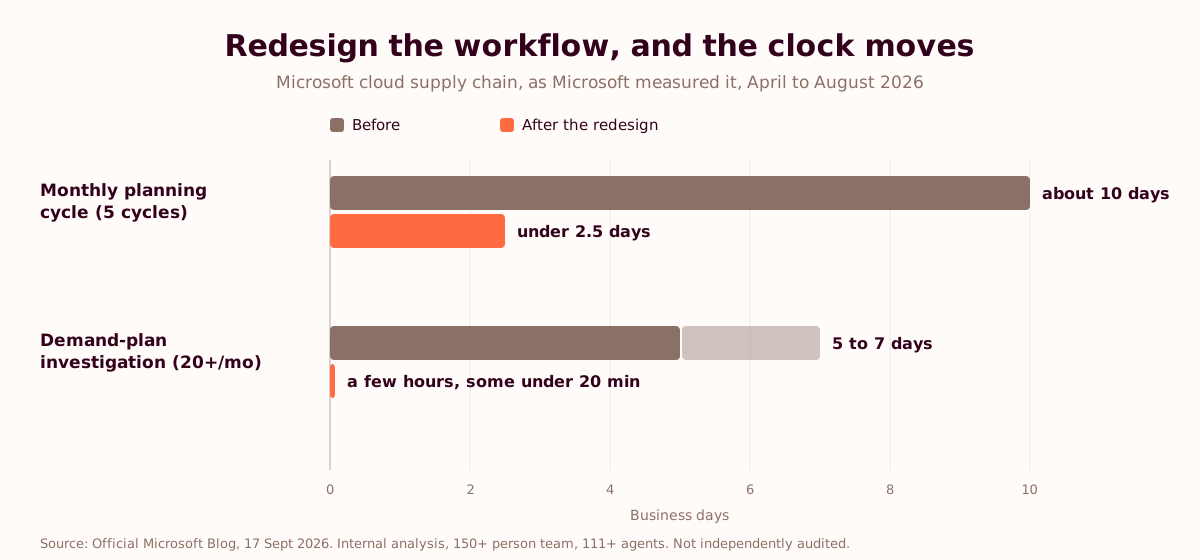
The supply chain story is the same shape with more agents. Microsoft's cloud supply chain experts and engineers mapped and simplified the end-to-end workflows first, then created a single source of truth so every agent worked from the same data. Only then did they deploy the agents: more than 111 of them by September 2026, across planning, sourcing, fulfilment and logistics.
Across five monthly planning cycles measured between April and August 2026, average cycle time fell from about 10 business days to under 2.5. Planners who used to spend five to seven days working out why a demand plan changed now get a human-validated answer in a few hours, sometimes in under 20 minutes.
One sentence from that section belongs on the wall of every steering committee that bought licences this year:
"Adding agents to a broken process still leaves a broken process [...] speeding up one step just creates a longer queue at the next."
Kathleen Hogan, Microsoft
That's the workshop problem, described by a supply chain team. The workshop speeds up one person at one step. The queue at the next step doesn't care.
The book
Microsoft needed 200,000 licences to learn this. It fits in one book.
Teach Them to Drive is the playbook we run with teams whose AI tools have been live for six months while the work stayed the same: why adoption stalls, how to find the real blocker, and a 90-day plan to change one workflow and measure it. Paperback and Kindle. Share it with whoever booked the last workshop.
Get Teach Them to Drive on Amazon →Why is AI adoption low after training?
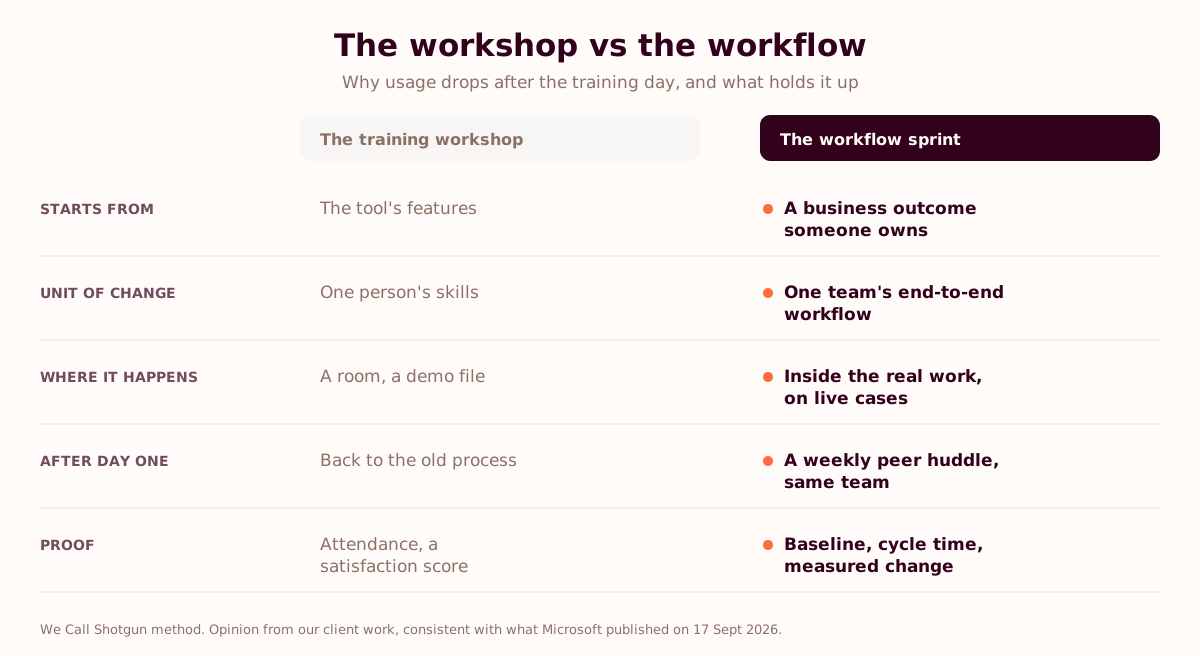
AI adoption is low after training because training changes one person's skills, while usage depends on the team's workflow, its goals and its manager. People go back to a process that has no step for the tool, so the tool becomes extra work and they quietly stop. Microsoft's write-up names four causes, and they match what we see in client teams.
1. The workflow didn't move
Someone learns to draft a report with Copilot. The report still goes through the same five approvals, in the same template, fed by the same export that takes a day to arrive. They save forty minutes on the draft and wait two days for the rest. The next month they don't bother. Our piece on training that sticks covers the same pattern from the training side.
2. Nobody owned a number
Microsoft's sales turnaround started when leaders "focused on a clear business outcome and what mattered most to the person doing the job, rather than AI adoption itself." A workshop's success metric is attendance and a satisfaction score. Neither one is anybody's quarterly target, so nobody chases it on Tuesday.
3. People learned alone
This is the part of Microsoft's post that reads like a confession. Describing Camp AIR, its internal accelerator, Hogan writes that "an early pilot taught us that AI transformation is a team sport and that tools and training alone were not enough." Individuals could learn the technology on their own. "Meaningful and lasting change occurred when teams learned, experimented and adapted together."
That's Microsoft, with its own tools and its own trainers, finding that the individual training model didn't hold.
4. The manager didn't go first
Microsoft cites its Work Trend Index research: when managers actively model AI use, reported value from agentic AI rises 17 points and trust in it rises 30 points. Employees on teams where managers create psychological safety are 1.4 times as likely to be high-frequency users of agentic AI (Microsoft Work Trend Index). Most workshops leave managers out of the room, or put them in it as attendees. We wrote a manager's playbook for exactly this gap.
"A workshop shows people where the pedals are. Then they drive home on the same road, in the same traffic, to the same job. Nobody redesigned the road."
Toni Dos Santos, co-founder of We Call Shotgun and author of Teach Them to Drive
Read the footnotes before you forward this to your CEO
Microsoft's numbers are good. They're also Microsoft's, about Microsoft's product, measured by Microsoft. The footnotes are honest about that, and anyone building a business case should quote them with the fine print attached.
- The sales figures are from 2024. They're based on 687 sellers between January and June 2024, comparing regular Copilot users (daily, at least 50% of the time) with low users. That's a comparison between people who used the tool and people who didn't. Strong sellers may simply have adopted first.
- The supply chain figures are specific. They come from a cross-functional team of more than 150 people working from September 2025 to August 2026, and Microsoft states the results are "specific to these workflows and measurement periods."
- The 35-day product release is one project. A nine-person team built the initial release of Copilot Cowork in 35 days. Microsoft's own note says it "is not a companywide product-development benchmark." We covered what Cowork does in our Copilot Cowork guide.
So why take the post seriously? Because of the part that runs against Microsoft's commercial interest. A company selling licences has published that 200,000 licences plus training didn't change the work. Vendors rarely say that about themselves. When one does, it's worth listening.
It also matches independent data. The CBI's Adoption Decade report with Oliver Wyman found that firms leading on AI deployment meet or exceed their expected return 49% of the time, against 15% for laggards, often on identical software. We unpacked it in our analysis of the execution divide.
Does that mean AI training is useless?
No, and Microsoft doesn't say it is. Its sales section is explicit: "Success still required investment in helping people build new skills, experiment with new ways of working and learn from one another." Skills still matter. What changes is where the learning happens and what it's attached to.
In the version that works, learning happens inside the redesign of one workflow, on live cases, with the whole team and its manager, and it's measured against a baseline. The skill-building is the delivery. The workflow change is the thing you're buying, and the thing the CFO can see.
That's why we don't sell workshops on their own. When a client asks for "AI training", the first question we ask is which number they want to move. If nobody can answer, the training day won't answer it either. We laid out the difference in AI advisory vs implementation vs training.
How do I get employees to use Copilot?
You get employees to use Copilot by redesigning one team's workflow around it, with a measured baseline, a weekly peer huddle and a manager who uses it in front of the team. Pushing usage without a workflow change tends to produce what Microsoft saw: a plateau. Here's the sequence we run with client teams, the same shape as Microsoft's sales and supply chain cases.
- Pick one workflow with a number attached. Tender responses, the monthly board pack, supplier onboarding, the weekly pipeline review. It has to repeat, and someone has to own a metric it moves.
- Measure it before anyone touches a tool. Cycle time from trigger to done, how many hands it passes through, where it waits. That baseline is what the CFO will ask for in 90 days.
- Map the real week. Microsoft mapped how account managers spent theirs. We sit with the people doing the work and write down the moments that matter, including the ugly ones: the copy-paste between systems, the chase for the missing number.
- Simplify, then add AI. Remove the steps that exist only because of old tools. Then match a capability to each moment. In Microsoft 365 that might be Researcher for account research, Analyst for the numbers, Copilot Notebooks for a project's working set (our Notebooks guide), Cowork for multi-step tasks.
- Run a weekly peer huddle. Thirty minutes, same team, real cases from that week: what worked, what broke, what to try next. That's how Microsoft says experimentation turned into habit.
- Put the manager in the driving seat. The manager runs their own work through the new flow first, in front of the team, including the bits that go wrong.
- Measure at 30, 60 and 90 days. Same metric as the baseline. If cycle time didn't move, the workflow is wrong, and you change the workflow before you blame the team.
This is the method in Teach Them to Drive, and it's how our Copilot adoption programmes run. It's also tool-agnostic. The same seven steps work on ChatGPT Enterprise, Gemini or Claude, which matters when the model underneath changes every few weeks (more on that here).
How to improve AI adoption at work, in one table
If you only have a minute before the steering committee, this is the swap.
| If you're measuring this | Measure this instead | Why |
|---|---|---|
| Licences assigned | Workflows redesigned, with an owner | Microsoft had 200,000+ licences and a plateau. |
| Workshop attendance | Weekly huddles held, per team | Microsoft credits the huddles with turning tests into habit. |
| Weekly active users | Adoption of priority use cases | The metric Microsoft saw triple in sales. |
| Hours saved (self-reported) | Cycle time against a baseline | The supply chain number that moved: about 10 days to under 2.5. |
| Satisfaction score | A business metric the team already owns | Close rate, revenue per head, time to answer. Something finance already reports. |
We wrote up the finance side in how to measure AI training ROI, and the ROI calculator turns your baseline into a range you can defend.
AI training for employees in the UK: what to ask before you buy
UK buyers searching for AI training for employees get quotes for days: a half-day workshop, a two-day course, a certificate. Before you sign one, ask the provider five questions. Their answers tell you whether you're buying a day or a change.
- Which workflow will be different in 90 days, and who owns its metric?
- What baseline do you take before the first session?
- Who runs the weekly huddle after you leave?
- What does the manager do differently, and when do they start?
- What do you report at day 30, 60 and 90, and in what unit?
If the answers are about agendas, venues and certificates, you're buying the version Microsoft stopped doing. Our UK guide to AI adoption training and the eight questions for L&D directors go further, and our UK page shows how we run it for teams in London and across the country.
Before the next workshop
Find the workflow worth redesigning first.
Twenty minutes with Toni or Meera. Bring the usage dashboard and the process that annoys everyone. You'll leave with the workflow to start on, the baseline to take, and what a 90-day sprint on it would change. Tool-agnostic, so nobody on the call is selling you a licence.
Book a 20-minute call →Rather see where you stand first? Run the free AI adoption diagnosis. Eight minutes, five dimensions, a scored report.
What Microsoft's post changes for the next budget conversation
For two years, the budget conversation about AI went: buy the licences, book the training, watch the dashboard. Microsoft ran that play on itself at a scale nobody else can, and published the result. Usage plateaued.
What worked for them was smaller and harder. One team, one outcome, the workflow rebuilt, a weekly habit, a manager in the room, a number measured before and after. That's work transformation, and it's what a training line in the budget should be buying.
The tool was never the problem. Nobody taught them to drive.
Frequently asked questions
Why does AI training fail after the workshop?
AI training fails after the workshop because it changes one person's skills while the team's workflow, targets and manager stay the same. People return to a process with no step for the tool, so it becomes extra work and usage drops. Microsoft reported the same pattern internally in September 2026: Copilot licensed to over 200,000 people did not change how work got done until teams redesigned workflows around business outcomes.
What did Microsoft learn from its own AI transformation?
In a post on 17 September 2026, Kathleen Hogan, Microsoft's Chief Strategy and Transformation Officer, set out five lessons: start with the business outcome, not the technology; redesign the entire workflow, not individual tasks; put employees at the centre; use AI to expand what people can do; and build a continuously learning organisation. She wrote that Microsoft initially treated AI as a traditional rollout of tools, training and adoption, and that this did not change how the work got done.
How many Microsoft employees had Copilot, and what happened to usage?
Microsoft says Copilot was licensed to over 200,000 people internally. In sales, despite broad deployment, usage plateaued and impact did not materialise. After the sales team started from business goals, mapped account managers' weeks, matched agents to specific moments and ran weekly peer-led huddles, adoption of priority use cases tripled, revenue per account manager rose 9.4% and close rates were 20% higher, based on 687 sellers in January to June 2024 compared with low-usage sellers.
Why is AI adoption low after training?
Four reasons show up repeatedly: the workflow didn't change, so the tool adds a step; nobody owns a business metric tied to its use; people learned alone instead of as a team; and managers don't model the new way of working. Microsoft's Work Trend Index found that when managers actively model AI use, reported value from agentic AI rises 17 points and trust rises 30 points.
How do I get employees to use Microsoft Copilot?
Pick one repeating workflow with a metric someone owns, measure its cycle time before any change, map the real week of the people doing it, simplify the process, then match Copilot capabilities such as Researcher, Analyst, Notebooks or Cowork to specific moments. Run a 30-minute weekly peer huddle, have the manager use the new flow first in front of the team, and re-measure at 30, 60 and 90 days against the baseline.
Is AI training a waste of money?
It can be, when it's bought as a standalone day. Microsoft says its successes still required investment in helping people build new skills. The difference is where learning happens: inside the redesign of a real workflow, with the whole team and its manager, measured against a baseline. Training sold as a standalone day, measured by attendance and satisfaction, is the model Microsoft moved away from.
What should UK companies look for in AI training for employees?
Ask any UK provider which workflow will be different in 90 days and who owns its metric, what baseline they take before the first session, who runs the weekly huddle after they leave, what managers do differently, and what they report at day 30, 60 and 90. Providers who answer with agendas, venues and certificates are selling the training-day model that Microsoft found did not change work on its own.
What is Microsoft Camp AIR?
Camp AIR is Microsoft's internal multi-week AI transformation accelerator. Cross-functional teams learn new AI capabilities while redesigning how they work together around a real business challenge. Microsoft says an early pilot showed that tools and training alone were not enough and that lasting change came when teams learned and adapted together. The programme has scaled to more than 3,000 engineers.
Sources and further reading
- Kathleen Hogan, "What we've learned from Microsoft's own AI transformation", Official Microsoft Blog, 17 September 2026, including footnotes 1 to 6
- Microsoft, Becoming a Frontier Firm: Our Frontier Playbook
- Microsoft, Work Trend Index: agents, human agency and the opportunity for every organization
- CBI and Oliver Wyman, The Adoption Decade: Closing the Execution Divide, August 2026, via our analysis
- Toni Dos Santos, Teach Them to Drive: The AI Adoption Playbook for Teams